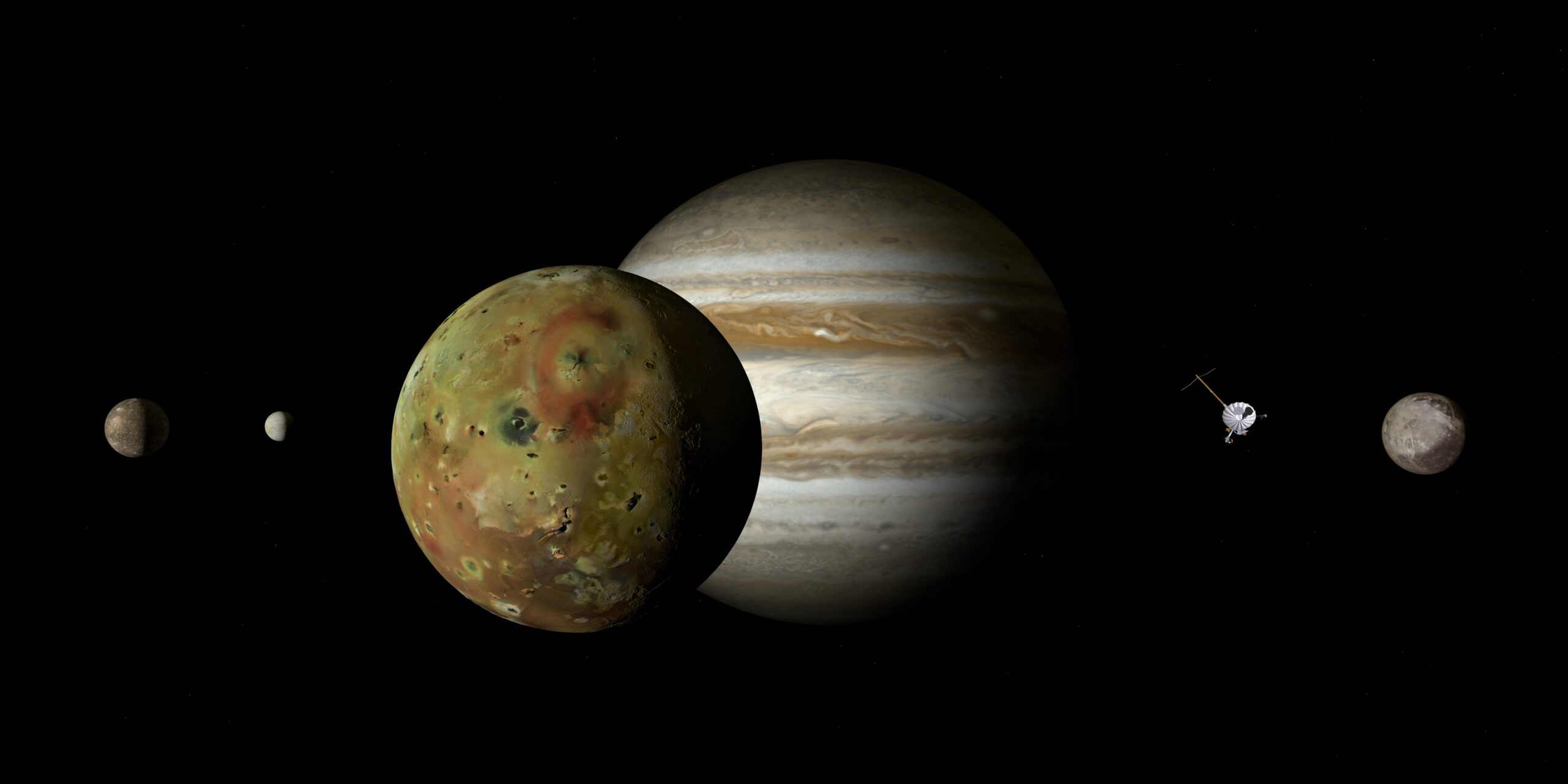
Introduction: The King of Planets, Through NASA’s Eyes
Jupiter has always commanded attention. It is the solar system’s undisputed monarch—318 times more massive than Earth, large enough to swallow every other planet whole, and host to a storm system that has raged for centuries. Yet for most of human history, it remained exactly what ancient astronomers perceived: a bright, steady wanderer against the fixed stars. A point of light. A mystery.
That changed dramatically in the 1970s, when NASA spacecraft began the long journey outward. Over the past five decades, a succession of increasingly sophisticated robotic explorers has transformed Jupiter from a fuzzy, striped disk into a living world of astonishing complexity. We have watched ammonia blizzards swirl at the poles. We have seen volcanic plumes on Io rise 300 kilometers above the surface. We have discovered that the Great Red Spot, far from being eternal, is slowly—inexorably—shrinking before our instruments’ eyes.
This is the story of those images. Not merely as scientific data, but as visual achievements: portraits of a planet captured from distances ranging from a half-billion miles to just a few thousand. Near and far, across four decades and five major NASA missions, here is how we have come to see Jupiter.
Part I: The Far View – Jupiter as a World in Context
The Voyager Era: First Contact
Before 1979, Jupiter was the province of telescopes—powerful ones, certainly, but Earthbound. The Pioneer 10 and 11 missions had returned grainy, pixel-thin glimpses in the early 1970s, sufficient to confirm that Jupiter was terrifyingly radioactive and possessed a magnetic field of incomprehensible strength. But Pioneer carried no imaging system designed for public release; its scientific instruments returned data, not postcards.
Voyager 1 changed everything.
When the spacecraft swept past Jupiter in March 1979, its imaging system revealed a planet of previously unimaginable complexity. The Great Red Spot, which Earth-based telescopes had rendered as a vaguely pink oval, resolved into a colossal atmospheric maelstrom spanning three Earths. Cloud bands previously described as “belts and zones” proved to be intricate, turbulent systems of ascending and descending gas, sheared by wind speeds exceeding 400 miles per hour .
The Voyager images, processed in false color to enhance subtle compositional differences, remain iconic half a century later. They established the visual vocabulary through which we understand Jupiter: the cream and ochre of ammonia ice clouds, the blue-gray of deeper atmospheric windows, the rust-red of unknown chromophores staining the Great Red Spot. These were not merely photographs; they were the first true portraits of an outer planet as a place, not a point of light.
Crucially, Voyager imaged Jupiter from afar—hundreds of thousands to millions of miles distant. The spacecraft never entered orbit; it conducted a high-speed flyby, using Jupiter’s immense gravity to slingshot toward Saturn. The resulting images show Jupiter as a full disk, a complete world floating in the blackness. This is the “far” perspective: comprehensive, contextual, revealing the planet as a whole system with rings, moons, and magnetosphere intact .
Hubble: The Unblinking Eye
Following Voyager, a decade passed without new Jupiter missions. But Earth orbit offered its own vantage point. The Hubble Space Telescope, launched in 1990, began providing annual Jupiter portraits that would prove scientifically invaluable and visually stunning.
Hubble’s advantage is consistency and longevity. While interplanetary missions offer brief, intense encounters, Hubble has monitored Jupiter for thirty-five continuous years. It witnessed the spectacular Comet Shoemaker-Levy 9 impacts in 1994. It has tracked the Great Red Spot’s contraction from approximately 25,000 miles across in 1979 to roughly 10,000 miles today. It has observed the seasonal变化 of Jupiter’s cloud bands and the emergence and dissipation of equatorial disturbances .
Hubble’s Jupiter images represent the “far” perspective at its most refined. From low Earth orbit—still half a billion miles from Jupiter—Hubble resolves features as small as 100 miles across, sufficient to distinguish individual storm systems and track their evolution over days, weeks, and years. The telescope’s longevity means that planetary scientists possess an unbroken visual record of Jupiter spanning three decades, a dataset impossible to obtain through any other means.
In November 2025, Hubble captured Jupiter in ultraviolet light, revealing high-altitude hazes and the distribution of stratospheric aerosols with extraordinary clarity . These images, processed in false color to render UV wavelengths visible to human eyes, transform Jupiter into something almost alien—a lavender and indigo world where familiar cloud bands become ghostly, translucent structures suspended above an unseen interior.
Webb: The Infrared Visionary
The James Webb Space Telescope, operating a million miles from Earth at the Sun-Earth L2 point, represents the ultimate expression of the “far” perspective. Webb does not observe Jupiter in visible light; its instruments are optimized for infrared wavelengths, penetrating the planet’s upper haze layers to reveal thermal structure and deep atmospheric circulation .
On January 18, 2026, NASA released a series of Webb Jupiter images that astonished even veteran planetary scientists . Captured during the telescope’s commissioning phase—while engineers were still verifying instrument performance—the images demonstrated Webb’s unexpected capability to observe bright, nearby objects with exquisite sensitivity.
What Webb revealed was unprecedented. Jupiter’s previously invisible dust ring, so faint that Voyager missed it entirely, appeared clearly in multiple infrared filters. Auroral emissions at both poles blazed with extraordinary intensity, the result of Webb’s sensitivity to ionized hydrogen emissions. Most remarkably, Webb detected the footprint of Io’s magnetic flux tube—a spot in Jupiter’s southern aurora where charged particles from Io’s volcanic plumes funnel along magnetic field lines and crash into Jupiter’s upper atmosphere .
Even more surprising was the appearance of Jupiter’s faint moons. Amalthea and Adrastea, tiny inner satellites lost in Jupiter’s glare when observed from Earth, resolved cleanly in Webb’s infrared camera. Thebe and Metis, smaller still, also appeared clearly—a discovery that NASA scientists described as “absolutely a surprise” .
“I could not believe we saw everything so clearly and how bright they were,” said Stefanie Milam, Webb project scientist. “It’s really exciting to think about the capability and opportunity we have to observe these types of objects in our solar system” .
Webb’s Jupiter images represent the “far” view at its most technologically refined. The telescope never approaches Jupiter; it remains fixed at L2, observing the planet as it swings through its distant orbit. Yet its resolution and sensitivity rival those of spacecraft flying past at close range—a testament to the power of large-aperture space telescopes.
Part II: The New Horizons Interlude – A Bridge Between Eras
Between the end of Galileo and the arrival of Juno, one spacecraft provided a fleeting but valuable interlude. New Horizons, destined for Pluto and the Kuiper Belt, conducted a high-speed Jupiter flyby in February 2007, using the planet’s gravity to gain 9,000 miles per hour of additional velocity .
The encounter lasted only a few days, but New Horizons carried an instrument ideally suited for Jupiter observation. The Long Range Reconnaissance Imager (LORRI) was a high-resolution panchromatic camera designed to resolve surface features on Pluto from vast distances. At Jupiter, it performed spectacularly, capturing details at scales Hubble could not match.
The resulting images, processed and released through the mission’s education and public outreach program, provided the highest-resolution views of Jovian atmospheric dynamics between the Galileo and Juno eras . LORRI captured the turbulent wake downstream of the Great Red Spot, the intricate structure of Jupiter’s faint ring system, and volcanic plumes on Io rising high above the moon’s surface.
New Horizons occupied a unique photographic niche: closer than Hubble or Webb, but not yet in orbit. Its Jupiter portraits show the planet as a disk too large for a single frame, requiring mosaic techniques to assemble complete global views. This is the “intermediate” perspective—near enough to resolve detailed atmospheric structure, far enough to retain context.
Part III: The Near View – Juno’s Intimate Portraits
Entering the Giant’s Embrace
On July 4, 2016, after a five-year cruise from Earth, NASA’s Juno spacecraft fired its main engine for thirty-five minutes and became the second human artifact ever to enter orbit around Jupiter . It was a make-or-break maneuver; had the burn failed, Juno would have sailed helplessly past the planet and into the outer darkness.
Juno’s mission design was radically different from Galileo’s. Rather than settling into a circular orbit, Juno adopted a highly elliptical, polar trajectory that carried it from a safe distance of several million miles to within 3,000 miles of Jupiter’s cloud tops—closer than any previous spacecraft. This “perijove” pass, repeated approximately once every thirty-eight days, allows Juno’s instruments to sample Jupiter’s near environment while minimizing exposure to the planet’s murderous radiation belts .
This orbital geometry has profound implications for imaging. From Juno’s perspective, Jupiter is never a full disk. The spacecraft plunges so close that the planet fills its field of view, revealing atmospheric features at scales impossible to resolve from Earth. Juno’s Jupiter is not a serene sphere floating against stars; it is a roiling, chaotic surface stretching to every horizon.
JunoCam: The People’s Camera
Juno carries a visible-light camera called JunoCam, specifically designed for public outreach. It is not a primary scientific instrument—it lacks the radiation shielding of Juno’s magnetometers and microwave radiometer—but it has become the mission’s public face, returning tens of thousands of images since orbit insertion .
JunoCam’s raw images are made immediately available on the mission website, accompanied by an open invitation: anyone with image processing software can download, enhance, and share their own versions. This citizen science program has produced many of the most memorable Jupiter images of the past decade, transformed by amateur processors worldwide into vivid, color-enhanced portraits .
The results are extraordinary. Björn Jónsson, a Icelandic software developer and amateur astronomer, has produced numerous JunoCam images that rival or exceed the quality of NASA’s official processed releases. His rendering of Jupiter’s north polar region reveals the mesmerizing central cyclone and its eight surrounding vortices in stunning detail . Seán Doran, a British graphic artist, has created dramatic colorizations of the Great Red Spot that emphasize the storm’s deep red core and surrounding turbulent wake .
Thomas Thomopoulos, the processor credited for the Astronomy Picture of the Day on January 6, 2026, enhanced a Juno image from December 2025 to show the southern hemisphere’s transition from orderly zones and belts into “a complex miasma of continent-sized storm swirls” . His processing choices—subtle texture enhancement and careful color balancing—reveal structure invisible in the raw data: the delicate filigree of ammonia cirrus, the dark lanes of downwelling gas, the bright puffs of convective uplift.
What Juno Has Seen
Twenty years from now, when the history of Jovian exploration is written, Juno’s greatest scientific achievements will likely involve its microwave radiometer and magnetometer—instruments that have peered beneath Jupiter’s clouds to reveal a complex, non-dipolar magnetic field and atmospheric structure extending hundreds of kilometers deep .
But for the public, Juno’s legacy will be visual.
The spacecraft has photographed:
- The Great Red Spot in unprecedented detail, revealing the storm’s deep red coloration as concentrated in a central “wisp” rather than uniformly distributed
- Polar cyclones arranged in geometric patterns—eight around the north pole, five around the south—that challenge atmospheric dynamicists’ understanding of vortex organization
- Brown barges—infrequent, diffuse oval storms in Jupiter’s equatorial belts—captured with unusual clarity during recent perijove passes
- Ammonia ice clouds in the northern temperate zone, swirling in chaotic patterns amid high-speed winds and deeper, warmer cloud structures
- The terminator zone where day meets night, revealing cloud topography through long shadows cast by towering convective systems
These are the “near” images—Jupiter not as a distant world, but as a landscape. When Juno passes 3,000 miles above the cloud tops, it photographs atmospheric features at resolutions of approximately 3-6 miles per pixel. Individual thunderstorms, tens of miles across, resolve clearly. The interplay of light and shadow across cloud decks creates three-dimensional depth that distant images cannot convey.
Part IV: Near Versus Far – What Different Vantage Points Reveal
The contrast between “near” and “far” Jupiter photography is not merely aesthetic; it is scientifically fundamental. Different distances reveal different phenomena, and the complete picture of Jupiter requires both perspectives.
Far images (Hubble, Webb, Voyager flybys, New Horizons distant observations) excel at:
- Global context: Understanding how atmospheric features relate across hemispheres and latitudes
- Temporal monitoring: Tracking the evolution of storms, belts, and zones over days, months, and years
- System context: Observing Jupiter simultaneously with its rings, moons, and magnetospheric phenomena
- Wavelength diversity: Hubble’s ultraviolet and Webb’s infrared capabilities exceed what can be practically flown on deep-space missions
Near images (Juno perijove passes) excel at:
- Spatial resolution: Revealing cloud morphology at scales impossible from Earth orbit
- Three-dimensional structure: Illuminating cloud topography through oblique viewing angles
- Fine-scale dynamics: Observing individual convective events, gravity waves, and turbulence
- Polar detail: The poles are foreshortened and difficult to observe from Earth; Juno passes directly over them
Neither perspective is superior. They are complementary, and contemporary Jovian science relies on both. Hubble monitors the Great Red Spot’s continued contraction; Juno photographs its cloud-top texture at 10-kilometer resolution. Webb maps ammonia distribution in the deep atmosphere; Juno measures it directly via microwave radiometry.
Part V: The Processing Pipeline – From Raw Data to Public Art
A persistent misconception among casual observers is that NASA spacecraft return photographs in the conventional sense—that Jupiter appears to Juno’s camera exactly as it appears in final released images. This is not accurate.
JunoCam is a color camera, but its raw output requires significant processing to produce visually interpretable images. The instrument captures separate exposures through red, green, and blue filters, which must be combined and aligned. The raw data is linear—proportional to incident light—while human vision perceives brightness logarithmically, requiring gamma correction. Contrast, sharpening, and color balance are applied not to deceive but to reveal structures that exist in the data but are invisible to unaided human perception .
The citizen science program has been remarkably successful. NASA estimates that over 10,000 individuals have participated in JunoCam processing since 2016. The best of these images are featured regularly in Astronomy Picture of the Day, scientific presentations, and mission press releases .
This collaboration between professional mission operations and amateur image processing represents a new model for public engagement in deep-space exploration. When the Cassini team released raw images, they were primarily utilized by enthusiasts; when Juno does the same, the resulting processed images become primary products that the mission itself relies upon for communication .
Part VI: The Future – What Comes After Juno
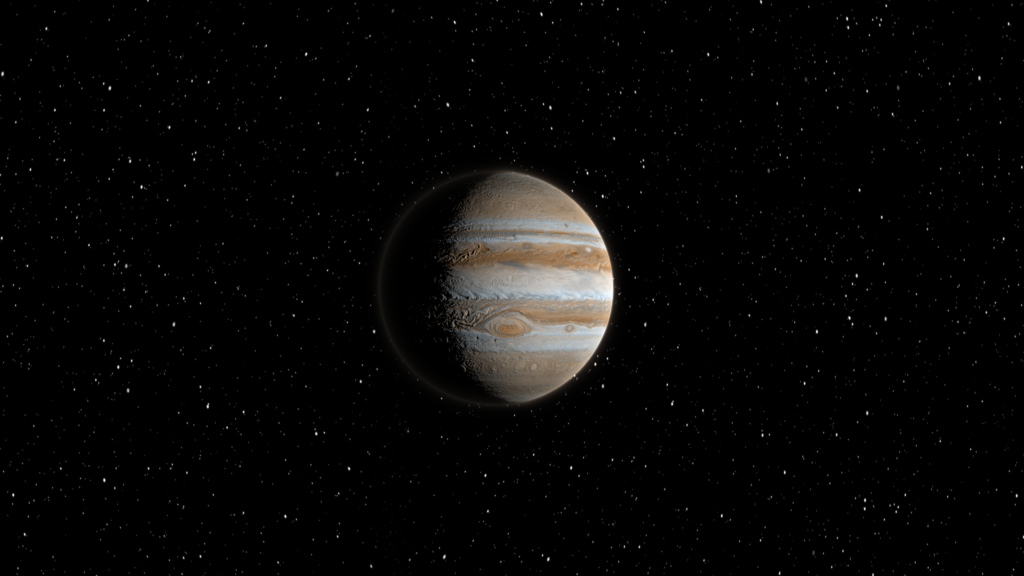
Juno remains healthy and continues its extended mission, with perijove passes scheduled through 2026 and beyond. The spacecraft has survived far longer than its design lifetime, though the relentless radiation environment is gradually degrading its systems. Eventually, like Cassini at Saturn, Juno will be commanded to plunge into Jupiter’s atmosphere, sacrificing itself to avoid contaminating Europa or Ganymede.
But Jupiter photography will not end with Juno.
NASA’s Europa Clipper, launched in 2024, carries a sophisticated imaging system that will photograph Jupiter continuously during its tour of the Jovian system. While primarily focused on Europa’s ice shell, Clipper’s cameras will inevitably capture Jupiter as a backdrop—the immense, banded planet looming over its fractured moon.
The European Space Agency’s JUICE (Jupiter Icy Moons Explorer), scheduled to arrive in the 2030s, will conduct high-resolution imaging of Ganymede and Callisto, with Jupiter as constant celestial companion.
And Webb continues to observe Jupiter annually, its infrared vision revealing atmospheric phenomena invisible to all previous telescopes.
Conclusion: The Unfinished Portrait
On January 6, 2026, the Astronomy Picture of the Day featured a Juno image of Jupiter’s southern clouds processed by Thomas Thomopoulos . It shows the transition zone where the planet’s familiar banded structure breaks down into turbulent chaos—continent-sized storm swirls, filamentary ammonia cirrus, dark lanes of clear gas between cloud decks. The image is stunning, yes. But more than that, it is evidence.
For five decades, NASA has been compiling a photographic portrait of Jupiter. It began with Voyager’s distant, full-disk images—Jupiter as a perfect sphere floating in velvet darkness. It continued with Hubble’s steady monitoring and New Horizons’ fleeting flyby. It reached its most intimate expression with Juno’s close approaches, revealing Jupiter as terrain, as landscape, as place.
But the portrait is not complete. It never will be.
Every spacecraft reveals complexities that previous missions missed. Every new wavelength exposes structures hidden from earlier instruments. Every improved resolution shows that what we previously thought was fine detail is actually coarse texture obscuring even finer detail beneath. Jupiter, like all worlds, recedes before our advancing knowledge.
The images we have are extraordinary. They represent the labor of thousands of scientists, engineers, and citizen volunteers, working across decades and continents. They have transformed our understanding of the solar system’s largest planet from a featureless point of light into a living, changing world of storms and clouds, auroras and rings, complexity and mystery.
And yet they remain, inevitably, incomplete.
This is not failure. It is invitation. The Jupiter portrait will be extended by Europa Clipper, by JUICE, by Webb’s continuing observations, and by missions not yet conceived. Each will add new strokes to an image that will never be finished because Jupiter itself will never be fully known.
The near and the far, the visible and the infrared, the global and the intimate—all are necessary. All contribute to a portrait that grows richer with every addition.
Jupiter rotates once every ten hours. Its clouds move at hundreds of miles per hour. Its storms form, merge, dissipate, and reform. The planet we photograph today is not the planet Voyager photographed in 1979, nor the planet Galileo photographed in 1996, nor the planet Webb photographed last month. It is always new, always different, always itself.
And we are always watching.
Image Gallery: NASA’s Jupiter Portfolio
| Spacecraft | Distance | Perspective | Notable Features | Wavelength |
|---|---|---|---|---|
| Voyager 1 | ~280,000 km | Flyby, full disk | First high-resolution Great Red Spot | Visible |
| Hubble | ~500 million km | Earth orbit, annual | 35-year continuous record | UV/Vis/IR |
| New Horizons | ~2.3 million km | High-speed flyby | Io plume, ring system | Panchromatic |
| Webb | ~600 million km | L2 orbit | Auroras, dust ring, faint moons | Infrared |
| Juno | ~3,000 km | Polar orbit, close approach | Cyclones, cloud texture, terminator | Visible |
Sources: NASA Jet Propulsion Laboratory, Southwest Research Institute, Space Telescope Science Institute, Astronomy Picture of the Day Archive