Chapter 1: The Consumer Graphics Revolution – GeForce RTX 50 Series
Projected Launch: “GeForce RTX 50 Series” (Codenamed “Blackwell” for Gaming)
- Expected Reveal: Q4 2025 (likely September/October)
- Key Specifications & Rumors (Based on Industry Leaks):
- GPU Architecture: Next-generation Blackwell (GB20x series) GPUs.
- Process Node: TSMC’s 3nm (N3) or enhanced 4nm (N4P) process, enabling significant density and efficiency gains.
- Core Technologies:
- DLSS 4: The anticipated next evolution of AI-powered upscaling, potentially introducing new frame generation technology and lower-latency processing.
- Ray Tracing 2.0 (RTX): Major hardware improvements to ray tracing cores for even more realistic lighting and reflections at higher performance.
- VRAM: Potential shift to GDDR7 memory across the lineup, offering massive bandwidth increases.
- Projected Models & Performance Leap:
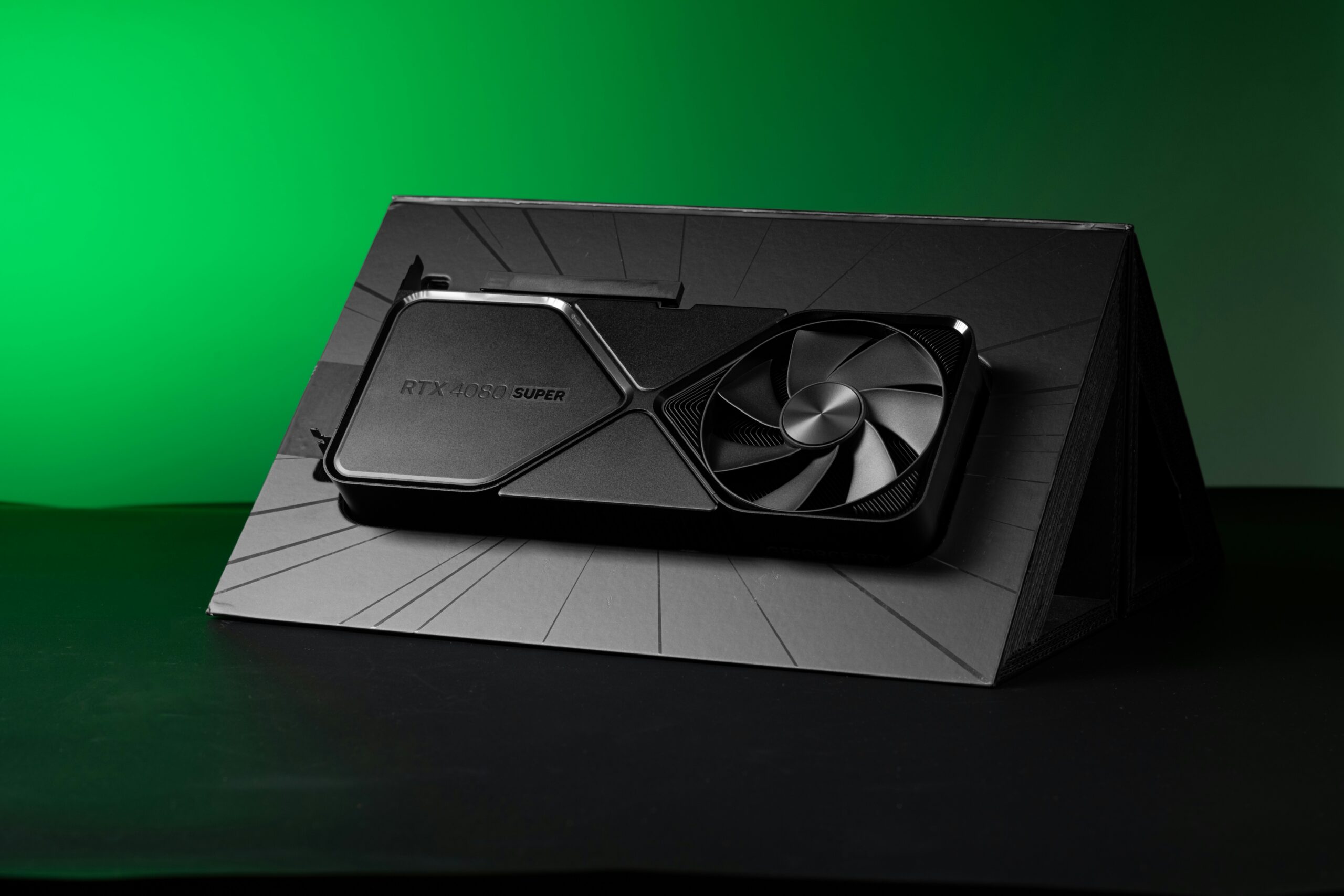
- RTX 5090: Expected to be the flagship, targeting a 60-80% performance uplift over the RTX 4090, especially in path-traced workloads.
- RTX 5080: Aimed at 4K gaming dominance, potentially offering RTX 4090-level performance at a lower tier.
- RTX 5070 & 5060: Targeting mainstream 1440p and high-refresh 1080p gaming with unprecedented efficiency.
- Market Impact: The RTX 50 series will be designed to solidify NVIDIA’s lead in gaming, professional visualization, and AI on the edge. It will further widen the feature gap with competitors through advanced AI and ray tracing capabilities.
- Anticipated Keynote: NVIDIA Special Event at CES 2025 or a Dedicated “GeForce Beyond” Event (Official channel link)
Chapter 2: The AI & Data Center Juggernaut – Blackwell Goes Full Throttle
2025 will be the first full year of shipments and deployments for NVIDIA’s Blackwell architecture in the data center, following its 2024 announcement.
1. The B100, B200, and GB200 Superchips
- Product: These are the successors to the H100 and GH200.
- Key Advancements:
- Unified GPU: A massive, monolithic GPU die delivering 3-4x the AI training performance of Hopper for Large Language Models (LLMs).
- Second-Generation Transformer Engine: Accelerated compute for the explosive growth of trillion-parameter models.
- Deployments: Expected to be in full production at major cloud providers (AWS, Azure, Google Cloud, Oracle Cloud) and sovereign AI initiatives worldwide.
2. NVIDIA Inference Microservices (NIM) & AI Foundry Expansion
- Strategy: In 2025, NVIDIA will aggressively expand its enterprise software layer.
- NIM: Pre-packaged, optimized containers for deploying AI models (like Llama 3, Stable Diffusion, NVIDIA’s own models) across accelerated infrastructure.
- AI Foundry Service: A partnership model with cloud providers to let enterprises fine-tune, customize, and deploy proprietary AI models on NVIDIA’s full stack (hardware + software).
Chapter 3: Automotive & Robotics – The Drive Towards Autonomous Machines
1. NVIDIA DRIVE Thor
- Status: Centralized car computer entering production with automakers in 2025 models.
- Capability: Consolidates infotainment, automated driving, and parking into a single AI compute platform, delivering 2,000 TOPS of performance.
- Partners: Expected in vehicles from companies like Zeekr, NIO, and other leading EV manufacturers.
2. NVIDIA Isaac Robotics Platform Advancements
- Focus for 2025: Broader adoption in logistics, manufacturing, and humanoid robotics.
- Key Products:
- New Jetson Orin Successor (Codename “Vernon”?): A next-generation system-on-module (SOM) for edge AI and robotics, offering more performance per watt.
- Isaac Sim: Continuous updates to the photorealistic, physics-accurate simulation platform for training and testing robots in virtual worlds before real-world deployment.
Chapter 4: Software, Platforms, and Ecosystems
1. NVIDIA Omniverse
- 2025 Focus: Transition from a pioneering tool to an industry standard for 3D collaboration and digital twin simulation.
- Key Developments: Deeper integration with major CAD and design software, expanded enterprise deployment in manufacturing, and urban planning.
2. AI Workbench & CUDA Evolution
- CUDA 13+: Further optimizations for Blackwell architecture and new AI workload types.
- AI Workbench: An enhanced toolkit to streamline the development and deployment of generative AI models across different infrastructure environments.
Chapter 5: Challenges and Market Dynamics in 2025
NVIDIA’s 2025 will not be without hurdles:
- Increased Competition: AMD’s Instinct MI400 series and Intel’s Falcon Shores in data centers; AMD RDNA 4 and Intel Battlemage in consumer graphics.
- Supply Chain & Demand Balance: Meeting the colossal, sustained demand for AI chips while launching a new consumer GPU series.
- Regulatory Scrutiny: Ongoing attention from regulators in the US, EU, and China regarding AI chip exports and market dominance.
Conclusion: The Year NVIDIA Defined the Next Decade
2025 will be a testament to NVIDIA’s execution on its long-term vision. It will be characterized by:
- Architectural Dominance: The Blackwell ramp across every segment—from gaming (RTX 50) to supercomputing (B100/B200).
- Software Monetization: A strategic shift from selling just hardware to selling a full-stack AI platform (NIM, Foundry, Omniverse subscriptions).
- Market Expansion: Cementing its role in the defining industries of the future: autonomous vehicles, robotics, and industrial digitalization.
For gamers, 2025 promises the most significant leap in graphics fidelity and performance since the original RTX launch. For enterprises and researchers, it provides the tools to build the next generation of AI. NVIDIA in 2025 is less of a product roadmap and more of a blueprint for the accelerated computing era.