
We are living through a seismic technological shift, one that is quietly embedding itself into the very fabric of our daily existence. Artificial Intelligence is no longer a futuristic concept confined to research labs or science fiction; it has become ambient, pervasive, and fundamentally ordinary. From the moment we wake to a smart alarm analyzing our sleep cycles to the personalized news feed we scroll through before bed, AI is the invisible engine powering, optimizing, and, increasingly, decision-making within our world. This “AI Everywhere” paradigm marks a transition from tool to environment—a new layer of intelligence integrated into the infrastructure of modern life.
The journey to ubiquity began with specialization. For decades, AI excelled in controlled, specific domains—defeating chess grandmasters, identifying cat videos, or translating documents. The breakthrough into the everyday was catalyzed by the convergence of three factors: the explosion of big data (the raw material for learning), advances in computational power (especially via GPUs), and the refinement of machine learning algorithms, particularly deep learning. This trifecta allowed AI to move from recognizing patterns in pixels and text to understanding context, generating content, and making probabilistic predictions about human behavior.
Today, this intelligence is woven into our lives through two primary channels: the personal and ambient, and the industrial and systemic.
On the personal front, AI has become our daily companion. It curates our digital experiences: the “For You” page on TikTok, the playlist Spotify generates based on your Monday morning mood, the product recommendations from Amazon that eerily predict a latent need. It mediates our communication through smart replies in Gmail and real-time transcription services. In our homes, AI-powered assistants like Alexa or Google Home manage our lighting, shopping lists, and entertainment, learning our habits and preferences. Our smartphones use AI for computational photography, turning mediocre snapshots into gallery-worthy images. Even our health is monitored by AI in wearable devices that track heart rate variability, predict potential illnesses, and nudge us toward healthier behaviors.
Beyond the consumer sphere, AI is revolutionizing industries invisibly but profoundly—the systemic layer. In healthcare, AI algorithms analyze medical images with superhuman accuracy, detecting cancers earlier than ever and accelerating drug discovery by simulating molecular interactions. In agriculture, it processes satellite imagery and soil data to optimize irrigation and predict crop yields, enabling precision farming. Logistics and transportation networks are managed by AI systems that dynamically route fleets, minimize fuel consumption, and power the autonomous vehicles slowly entering our streets. The financial sector relies on AI for fraud detection, algorithmic trading, and risk assessment, parsing through petabytes of transactions in milliseconds to identify anomalous patterns.
Furthermore, the creative and cognitive domains are no longer human monopolies. Generative AI models like DALL-E, Midjourney, and ChatGPT have exploded into public consciousness, democratizing the ability to create convincing text, images, music, and code from simple prompts. This is not just automation; it is co-creation. Writers brainstorm with LLMs, designers use AI to rapidly iterate concepts, and programmers delegate boilerplate code to Copilot. AI is becoming a collaborative partner in the creative process, augmenting human imagination and productivity.
However, the era of “AI Everywhere” is not an unalloyed triumph. It brings with it a constellation of ethical, social, and existential challenges that we are only beginning to grapple with.
- Bias and Fairness: AI systems learn from historical data, which often encodes human prejudices. This can lead to discriminatory outcomes in hiring, lending, policing, and justice. An “everywhere” AI risks automating and scaling bias, making it systemic and harder to detect.
- Privacy Erosion: The fuel for ubiquitous AI is data—our data. The constant harvesting of personal information to train and refine models creates a panopticon of surveillance, often without meaningful consent. The line between personalization and intrusion grows perilously thin.
- Opacity and Accountability: Many powerful AI models, especially deep learning systems, are “black boxes.” Their decision-making processes are inscrutable, raising critical questions: When an AI denies a loan, diagnoses a disease, or recommends a parole decision, who is accountable? The need for explainable AI (XAI) is paramount.
- Economic Disruption and the Future of Work: While AI augments many jobs, it displaces others. The automation of cognitive and creative tasks threatens a new wave of workforce disruption, demanding massive investments in reskilling and a societal rethink of the relationship between work, income, and purpose.
- The Authenticity Crisis: Generative AI blurs the line between human and machine output, fueling disinformation, deepfakes, and a corrosion of trust in what we see, hear, and read. The epistemic foundations of our society are under stress.
Navigating this new reality requires a framework that is both bold and prudent. We must move beyond the simplistic dichotomy of techno-optimism versus doom. The path forward involves:
- Robust and Adaptive Governance: We need intelligent regulation—not to stifle innovation but to establish guardrails. This includes standards for algorithmic auditing, strict data protection laws (like GDPR), and clear liability frameworks for AI-caused harm. Regulation must be principle-based and agile to keep pace with the technology.
- Ethics by Design: Ethical considerations cannot be an afterthought. Fairness, transparency, privacy, and human oversight must be embedded into the AI development lifecycle, from initial design to deployment and monitoring.
- Democratization of Understanding: We must foster widespread AI literacy, not at the coding level, but at the civic level. People need to understand AI’s capabilities, limitations, and potential for manipulation to be empowered citizens, not passive subjects.
- Human-Centric Augmentation: The goal should be to design AI that amplifies human agency, creativity, and dignity. The focus must be on partnership—using AI to tackle grand challenges like climate change and disease, while freeing humans to focus on meaning, connection, and the uniquely human capacities of empathy, ethics, and wisdom.
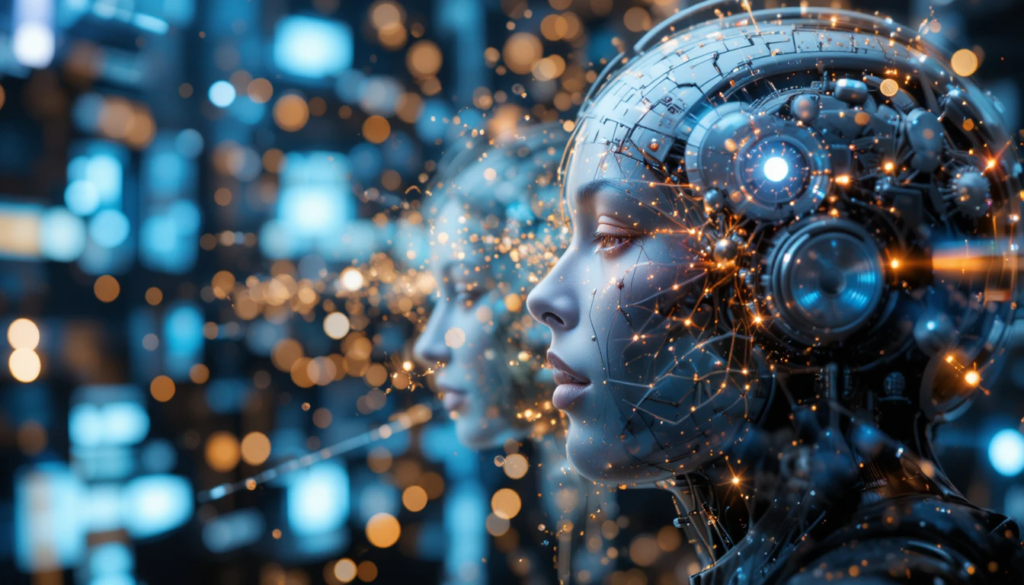
The “AI Everywhere” future is not a destination we arrive at passively; it is a reality we are actively constructing with every line of code, every data policy, and every product we adopt. Its ultimate character is still undetermined. It holds the promise of a golden age of abundance, health, and creativity—a world where AI handles mundane tasks and complex optimizations, allowing humanity to reach new heights. Yet, it equally holds the risk of entrenched inequality, diminished autonomy, and a destabilized truth.
The intelligence is becoming ubiquitous. The crucial question that remains is: What kind of intelligence will we instill in it, and what wisdom will we, its creators, exercise in its stewardship? The answer will define the next century of human experience. AI is everywhere, and thus, its future is inextricably our own.