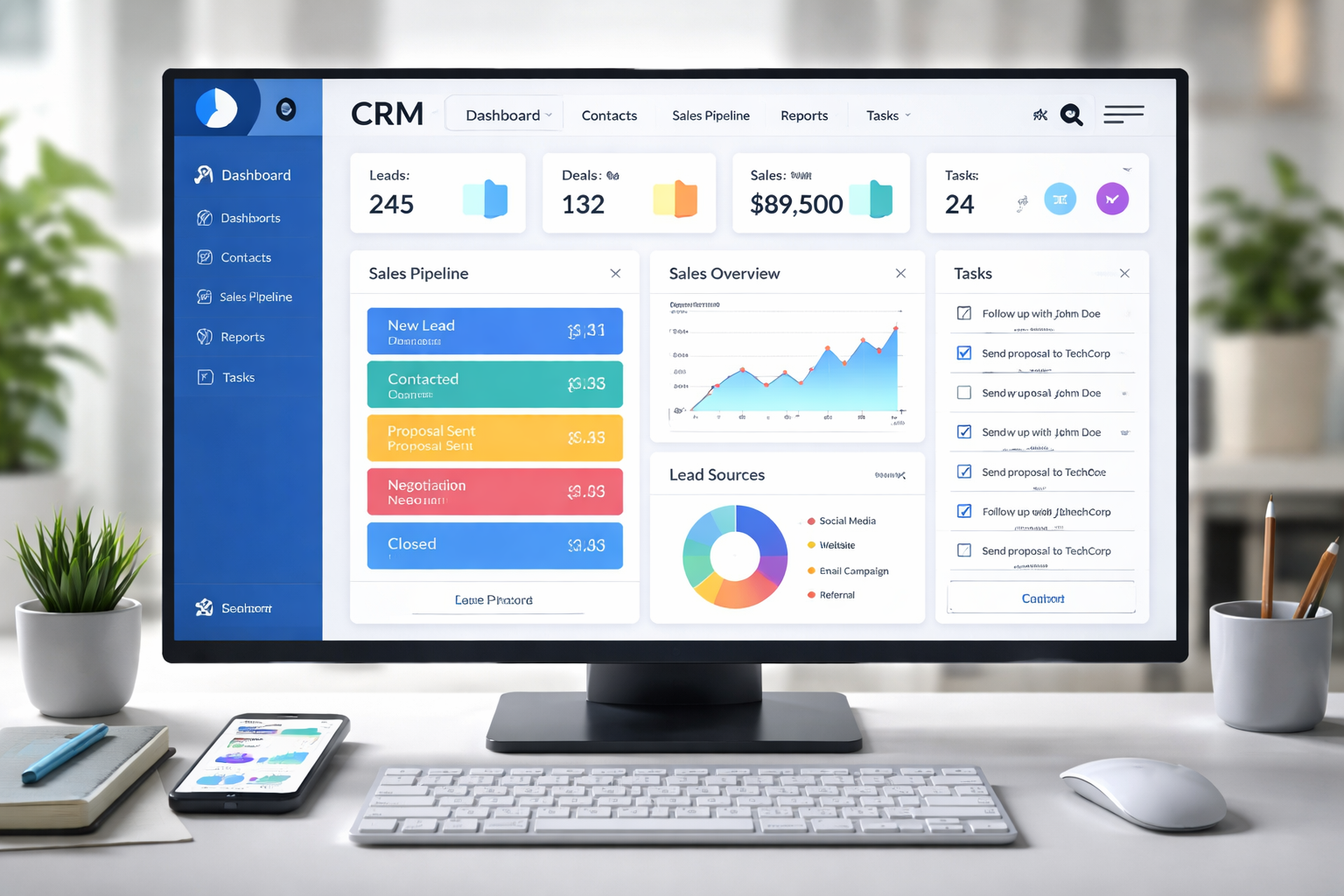
Introduction: Why Your CRM Software Choice Has Never Mattered More
Customer Relationship Management software has fundamentally outgrown its origins as a glorified contact database. In 2026, the right CRM is the central nervous system of your entire revenue operation — connecting sales, marketing, and customer service into one intelligence-driven engine.
The numbers back this up. The global CRM market was valued at $112.91 billion in 2025 and is projected to reach $320.99 billion by 2034, growing at a CAGR of 12.40%. Meanwhile, businesses that use CRM systems see about 27% higher customer retention, and roughly 47% of CRM users report major improvements in customer satisfaction after adopting a platform.
But perhaps the most compelling case for upgrading your CRM comes from the AI revolution reshaping the category. Businesses using AI within their CRM are 83% more likely to exceed their sales goals, and AI improves sales forecast accuracy by over 40%.
With hundreds of platforms competing for your budget, this guide cuts through the noise and identifies the best CRM software available today — broken down by business size, use case, and budget.
What Is CRM Software?
CRM software is a digital tool designed for businesses to efficiently organize, monitor, and maintain data about existing and prospective customers. The best CRM software centralizes data from various lead generation, traffic, campaign, and acquisition sources and creates unified records and profiles.
Modern platforms go much further than contact management. In 2026, CRM tools have evolved into sophisticated ecosystems that predict customer behavior, automate mundane tasks, and help sales teams close deals faster.
Key Features to Look for in a CRM (2026 Checklist)
Before comparing platforms, it helps to know what separates a great CRM from an average one. Here are the capabilities that matter most right now:
- AI-powered lead scoring — Predictive lead scoring uses historical data to identify which prospects are most likely to convert, helping sales teams prioritize their efforts effectively.
- Automation workflows — Automating repetitive tasks like follow-up emails, data entry, and task assignments keeps your team focused on selling.
- Omnichannel support — 79% of customers expect a consistent experience across all channels, which CRM platforms help unify.
- Mobile access — Nearly 81% of CRM users access their system from multiple devices, ensuring seamless workflow.
- Integrations — Deep compatibility with your existing tools (email, marketing, ERP) is non-negotiable.
- Scalability — Your CRM should grow with you, from startup to enterprise.
The Best CRM Software of 2026
1. Salesforce Sales Cloud — Best for Enterprises & Complex Sales
Best for: Large organizations, complex sales cycles, deep customization Starting price: ~$25/user/month (Starter Suite)
Salesforce has been the undisputed leader in CRM for years, and it’s not slowing down. Its Einstein AI tool helps businesses automate complex tasks such as email management and sales forecasting, and it integrates seamlessly with practically any other business software.
Salesforce offers modules for four core areas — Sales, Service, Marketing, and Commerce — in addition to tools for cloud data management, collaboration, and more. Einstein AI, Salesforce’s custom digital assistant, is embedded throughout to automate repetitive tasks and help teams close deals, launch campaigns, and resolve tickets faster.
In January 2026, Salesforce committed $4 billion to expand data-center capacity across Europe, Japan, and Australia to support its Agentforce and Einstein AI workloads — a clear signal of where the platform is headed.
Pros: Unmatched customization, enterprise-grade analytics, massive integration ecosystem Cons: Steep learning curve, higher total cost of ownership, requires dedicated admin
2. HubSpot CRM — Best for Marketing-Driven Businesses & SMBs
Best for: Small to mid-sized businesses, inbound marketing teams Starting price: Free tier available; paid plans from ~$15/user/month
HubSpot is the best choice for marketing-driven businesses. As the spearhead of the inbound marketing movement, HubSpot has designed software hubs that center marketing activities throughout the buyer journey — even long after a prospect becomes a customer.
HubSpot is known for its user-friendly interface, strong marketing automation features, and excellent customer support, making it ideal for small to medium-sized businesses. Marketing, sales, and support all live in one place, and onboarding is fast.
One real-world example of its impact: the team at McKonly & Asbury adopted HubSpot to prioritize customer experience across every team, gaining a complete view of accounts and the flexibility to send personalized messages.
Pros: Generous free tier, intuitive UI, strong marketing automation, fast time-to-value Cons: Costs can escalate quickly as you add advanced automation and custom reporting
3. Microsoft Dynamics 365 — Best for Microsoft Ecosystem Users
Best for: Enterprises already using Microsoft 365, Azure, or Teams Starting price: ~$65/user/month (Sales Professional)
Microsoft has made aggressive moves in 2025–2026 to AI-power its CRM offering. Microsoft embedded Copilot into Dynamics 365 Sales, Customer Service, and Marketing, with early adopters citing 15–20% administrative savings. For businesses already living in the Microsoft ecosystem, Dynamics 365 offers unrivalled native integration with Teams, Outlook, Excel, and Azure.
Pros: Deep Microsoft 365 integration, powerful AI via Copilot, enterprise-grade security Cons: Can be complex to configure, expensive for smaller teams
4. Zoho CRM — Best Budget-Friendly Option
Best for: Budget-conscious teams, SMBs wanting broad feature coverage Starting price: Free for up to 3 users; paid plans from ~$14/user/month
Zoho is often praised for its affordability and wide range of features. It suits teams that need a full toolset without the price tag of Salesforce or HubSpot — though some users find its interface less intuitive than competitors.
Zoho offers everything from contact management and pipeline tracking to marketing automation, analytics, and an AI assistant called Zia. Its breadth of functionality at its price point is genuinely hard to beat for cost-sensitive teams.
Pros: Excellent value, wide feature set, good AI features via Zia Cons: Interface can feel cluttered, some features lack polish
5. Pipedrive — Best for Sales-Focused Teams
Best for: Pure-play sales teams, pipeline management, high-volume outreach Starting price: ~$14/user/month (Essential)
Pipedrive shines for pure sales execution — simple pipelines, high adoption rates, and a strong mobile experience. It does have limited native marketing and service features, so teams often add tools around it.
Pipedrive’s visual pipeline interface is arguably the most intuitive in its class, making it a popular choice for teams where rep adoption is a concern.
Pros: Extremely user-friendly, visual pipeline, great mobile app, fast onboarding Cons: Limited built-in marketing tools, not ideal for complex enterprise needs
6. Freshsales (Freshworks) — Best for Growing Teams
Best for: Mid-market teams wanting AI features without enterprise complexity Starting price: Free tier available; paid plans from ~$9/user/month
Freshsales combines an intuitive interface with a capable AI assistant called Freddy AI, which handles lead scoring, deal insights, and next-best-action recommendations. It sits in a sweet spot between HubSpot’s marketing power and Pipedrive’s sales focus — making it a strong pick for growing teams that don’t yet need Salesforce’s complexity.
Pros: Affordable, built-in phone and email, good AI features, easy setup Cons: Reporting less powerful than Salesforce; ecosystem smaller than HubSpot
CRM Comparison Table
| CRM | Best For | Free Plan | Starting Price | AI Features |
|---|---|---|---|---|
| Salesforce | Enterprise | ✗ | ~$25/user/mo | ✅ Einstein AI |
| HubSpot | SMB / Marketing | ✅ | ~$15/user/mo | ✅ Breeze AI |
| Microsoft Dynamics 365 | Microsoft shops | ✗ | ~$65/user/mo | ✅ Copilot |
| Zoho CRM | Budget teams | ✅ (3 users) | ~$14/user/mo | ✅ Zia |
| Pipedrive | Sales teams | ✗ | ~$14/user/mo | ✅ Limited |
| Freshsales | Growing teams | ✅ | ~$9/user/mo | ✅ Freddy AI |
Pricing as of February 2026. Always verify on vendor websites as plans change frequently.
How to Choose the Right CRM for Your Business
Picking a CRM isn’t about finding the “best” one in the abstract — it’s about finding the best one for your team’s specific context. Here’s a practical framework:
Step 1 — Map your core workflows. What does your sales process actually look like? How many stages are in your pipeline? Do you need marketing automation baked in, or do you have a separate tool?
Step 2 — Check integration requirements. If you’ve tried to build a patchwork tech stack, you know how finicky software connections can be. Modern CRM solutions are designed to integrate seamlessly with a variety of tools to maximize uptime and ensure everyone has access to vital business data.
Step 3 — Run a small pilot before committing. A CRM that reps don’t use is worse than no CRM at all. Test adoption with a small team before rolling out company-wide.
Step 4 — Plan your data model on day one. Establishing clean property hygiene and a clear data structure at the start saves months of painful migration work later.
As a general rule of thumb: startups and SMBs often do best with HubSpot or Pipedrive for adoption. Mid-to-large companies with complex systems often land on Salesforce. Cost-sensitive teams with broad needs frequently consider Zoho.
The Role of AI in CRM: 2026 and Beyond
AI is no longer a differentiating feature in CRM — it’s the baseline. In 2026, AI isn’t a novelty feature; it’s table stakes for competitive CRM platforms. Conversation intelligence analyzes calls and emails to highlight customer sentiments, objections, and opportunities that reps might otherwise miss. Automated data entry captures information from emails, calls, and meetings, eliminating tedious manual input.
65% of businesses have already adopted CRM systems with generative AI, with projections showing over 70% of all platforms will be AI-integrated by the end of 2025 — positioning any CRM without robust AI as legacy technology.
The platforms leaning furthest into this shift are Salesforce (Agentforce + Einstein), Microsoft Dynamics (Copilot), and HubSpot (Breeze AI). If AI-driven automation is a priority for your team, these three should be at the top of your shortlist.
Frequently Asked Questions
What is the best free CRM software? HubSpot offers the most capable free tier on the market, including contact management, deal tracking, email tools, and reporting. Zoho CRM and Freshsales also have free plans worth evaluating for smaller teams.
Which CRM is best for small businesses? HubSpot and Pipedrive are the most popular choices for small businesses due to their ease of use and fast time-to-value. For very budget-conscious teams, Zoho CRM offers exceptional breadth at a low price.
Is Salesforce worth it for small businesses? Generally, no — not right away. Salesforce is powerful but expensive and complex to administer. Most small businesses are better served by HubSpot, Pipedrive, or Freshsales until they hit a scale that justifies Salesforce’s cost and overhead.
What is the ROI of CRM software? Businesses that use CRM systems see about 27% higher customer retention and roughly 47% of CRM users report major improvements in customer satisfaction. In financial terms, businesses using CRM software experience a 300% increase in conversion rates on average.
How important is mobile CRM access? Very. Nearly 81% of CRM users access their system from multiple devices, ensuring convenience and a seamless workflow — making mobile-first design a key evaluation criterion.
Final Verdict
There’s no single “best” CRM — but there is a best CRM for you. Here’s the quick-reference breakdown:
- Best overall for enterprises: Salesforce Sales Cloud
- Best for marketing-driven SMBs: HubSpot CRM
- Best for Microsoft shops: Microsoft Dynamics 365
- Best budget option: Zoho CRM
- Best for pure sales teams: Pipedrive
- Best for growing mid-market teams: Freshsales
Whichever platform you choose, the most important thing is actually using it consistently. A well-adopted mid-tier CRM will always outperform an under-used enterprise platform.
Sources & Citations
- Fortune Business Insights — Customer Relationship Management Market Size (2025). https://www.fortunebusinessinsights.com/customer-relationship-management-crm-market-103418
- SellersCommerce — Top CRM Statistics You Need to Know in 2025 (December 2025). https://www.sellerscommerce.com/blog/crm-statistics/
- TechRadar — 13 Best CRM Platforms in 2025: Tested and Reviewed (January 2026). https://www.techradar.com/best/the-best-crm-software
- Mordor Intelligence — Customer Relationship Management Market Size & Forecast (January 2026). https://www.mordorintelligence.com/industry-reports/customer-relationship-management-market
- G2 — Best CRM Software: User Reviews (February 2026). https://www.g2.com/categories/crm
- Cargas — The Best CRM Software for 2026 (January 2026). https://cargas.com/blog/the-best-crm-software-solutions/
- Kixie — CRM Statistics and Market Insights for 2025 (August 2025). https://www.kixie.com/sales-blog/crm-statistics-and-market-insights-for-2025/
- DemandSage — 42 Latest CRM Statistics 2026 (January 2026). https://www.demandsage.com/crm-statistics/
- MarketsandMarkets — Top CRM Tools to Supercharge Your Sales in 2026 (December 2025). https://www.marketsandmarkets.com/AI-sales/top-crm-tools-2026
- HubSpot Community — Best CRM Software in 2025 (December 2024). https://community.hubspot.com/t5/CRM/Best-CRM-Software-in-2025/td-p/1083714
This article was last updated in February 2026. Pricing and features are subject to change — always verify details directly with vendors before purchasing.